
🌿 Aquarium Nitrogen Cycle: 6 Easy Steps to a Perfect Setup
Setting up a new aquarium is one of the most exciting parts of becoming a fish keeper. Watching a beautiful tank come together, choosing colorful fish, and creating a peaceful underwater environment is something many aquarium enthusiasts look forward to.
However, before adding your first fish, there is one critical biological process you absolutely must understand—the aquarium nitrogen cycle.
⚠️ The Golden Rule: Clear water does NOT always mean safe water. A brand-new aquarium may appear perfectly healthy, but it lacks the beneficial bacteria needed to process harmful waste. Without mastering the aquarium nitrogen cycle, toxic compounds build up quickly and can stress, injure, or even kill fish within days.
The aquarium nitrogen cycle is the natural filtration system that keeps every healthy aquarium alive. It transforms dangerous waste products into much safer compounds, allowing fish, plants, and beneficial microorganisms to live together in balance. Whether you own a small freshwater aquarium, a planted aquascape, or a large community tank, understanding this biological cycle will make the difference between a thriving aquarium and one filled with constant problems.
🔍 What Is the Aquarium Nitrogen Cycle?
The aquarium nitrogen cycle is a natural biological process that converts toxic waste into less harmful substances through the action of beneficial bacteria.
Every aquarium continuously produces waste. Fish release waste through their gills and digestive system, uneaten food begins to decompose, dead plant leaves break down, and even tiny organic particles trapped in the substrate contribute to waste production.
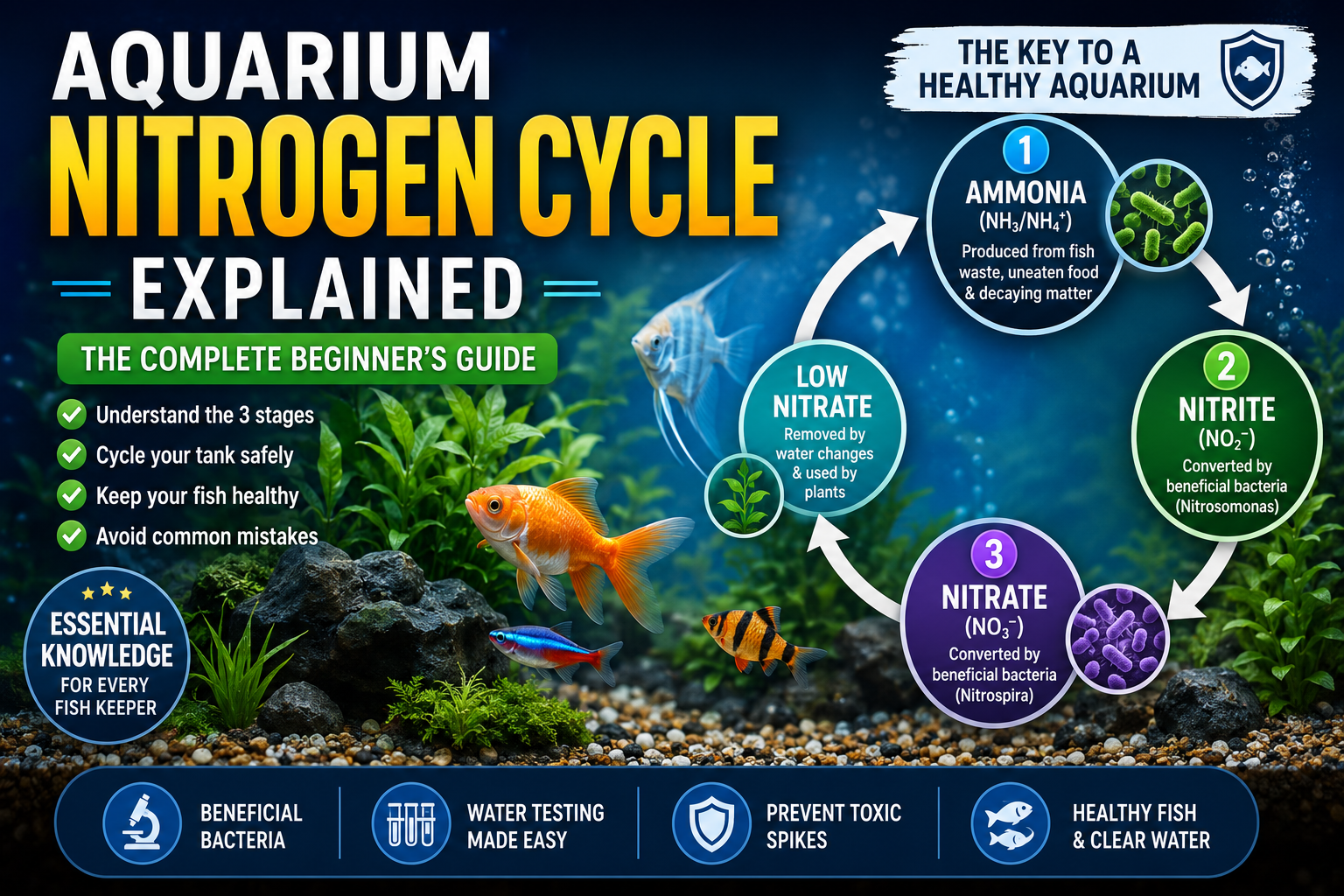
As these materials decompose, they release Ammonia ($NH_3$), one of the most toxic chemicals that can exist inside an aquarium. Even very small concentrations of ammonia can burn fish gills, damage internal organs, weaken the immune system, and eventually lead to death if left untreated.
💡 Nature’s Solution
Special colonies of beneficial bacteria develop inside the aquarium and begin consuming ammonia as their food source during the aquarium nitrogen cycle:
-
First Step: Bacteria convert toxic ammonia into Nitrite, another dangerous chemical.
-
Second Step: A second group of bacteria then converts nitrite into Nitrate, which is far less harmful and can be easily controlled through regular water changes and healthy plant growth.
🛡️ Why the Nitrogen Cycle Is Essential
The aquarium nitrogen cycle is often called the true foundation of aquarium keeping because every healthy tank depends on it. Beginners frequently spend hundreds of dollars on beautiful decorations, premium filters, expensive lighting, and colorful fish, yet overlook the one thing that matters most: biological filtration.
When a tank has not completed its aquarium nitrogen cycle, toxic ammonia begins accumulating almost immediately after fish are introduced. Since beneficial bacteria are not yet present in sufficient numbers, the organic waste has nowhere to go.
🚨 New Tank Syndrome
Fish living in an uncycled aquarium may experience severe health issues due to a lack of biological filtration. Common symptoms include:
-
🫁 Difficulty Breathing: Gasping near the water surface or crowding near filter outputs.
-
🛑 Physical Damage: Red, inflamed, or bleeding gills.
-
🍽️ Behavioral Changes: Complete loss of appetite and energy.
-
💤 Lethargy: Sluggish swimming and tightly clamped fins.
-
👁️ Infections: Cloudy eyes or fuzzy white patches on the scales.
-
🦠 Weak Immunity: High susceptibility to infectious diseases like Ich.
-
☠️ Fatal Spikes: Sudden, unexplained livestock deaths overnight.
Once the aquarium nitrogen cycle becomes fully established, the aquarium becomes far more stable. Water quality improves, fish become healthier, algae problems often decrease, and routine maintenance becomes significantly easier.
📊 Understanding the Three Stages of the Nitrogen Cycle
Although the aquarium nitrogen cycle may sound complicated, it follows three simple biological stages that every fish keeper can monitor.
🔹 Stage One: Ammonia Production
Everything begins with ammonia. It enters the aquarium from several different organic sources:
-
Fish waste, urine, and gill secretions.
-
Uneaten fish food breaking down on the bottom.
-
Decaying organic matter inside a dirty, unsiphoned substrate.
This is the most dangerous stage because ammonia is extremely toxic. Concentrations as low as 0.25 ppm can begin stressing sensitive fish species. Ideally, a mature aquarium should always maintain an ammonia level of 0 ppm.
🔹 Stage Two: Nitrite Formation
Once ammonia-producing waste begins accumulating, the first colony of beneficial bacteria starts growing. These bacteria belong primarily to the genus Nitrosomonas. Their job is to consume ammonia and convert it into Nitrite ($NO_2^-$).
While this represents progress in the aquarium nitrogen cycle, nitrite is still extremely dangerous. It interferes with the ability of fish blood to transport oxygen throughout the body—a fatal condition sometimes called Brown Blood Disease.
Just like ammonia, nitrite should always remain at 0 ppm in a fully cycled aquarium.
🔹 Stage Three: Nitrate Formation
As the second bacterial colony develops, another group of beneficial bacteria—primarily Nitrospira—begins converting nitrite into Nitrate ($NO_3^-$).
Unlike ammonia and nitrite, nitrate is considerably less toxic. Small amounts of nitrate are generally safe for most freshwater fish. However, high nitrate levels over long periods can cause chronic stress. For most freshwater aquariums, keeping nitrate below 20–40 ppm is considered a good target.
🧫 Where Do Beneficial Bacteria Live?
One of the biggest misconceptions among beginner aquarists is that beneficial bacteria primarily live in the aquarium water. In reality, only a tiny percentage of these microorganisms are free-floating. The overwhelming majority attach themselves to hard surfaces where water constantly flows over them.
The largest colonies of beneficial bacteria are typically found inside the filter media (Sponge filters, ceramic rings, bio-balls, lava rock). They also grow on:
-
Aquarium gravel and sand substrates.
-
Porous rocks and natural driftwood.
-
Decorations, glass surfaces, and live plants.
🛑 Pro Tip: Never replace all of your filter media at once, and never rinse it under untreated tap water! Chlorine and chloramine will instantly kill your beneficial bacteria, unintentionally restarting your aquarium nitrogen cycle from scratch. Instead, gently rinse it in old aquarium water during routine water changes.
🔄 Fishless Cycling vs. Fish-In Cycling
There are two primary methods for establishing the aquarium nitrogen cycle. Although both can produce a healthy aquarium, one is significantly safer than the other.
1️⃣ Fishless Cycling (The Gold Standard)
Instead of exposing live fish to toxic chemicals, the aquarist adds an artificial ammonia source to feed beneficial bacteria while the aquarium remains empty.
-
Sources: Pure household ammonia, fish food allowed to decompose, or commercial ammonium chloride solutions.
-
Advantages: No fish are harmed, larger bacterial colonies develop, and there is a much lower risk of future disease outbreaks.
2️⃣ Fish-In Cycling (High Risk)
Some hobbyists choose to cycle an aquarium while fish are already living inside it. This method requires intense daily testing and frequent partial water changes to keep toxic levels low enough for the fish to survive. For beginners, this method is not recommended due to the high workload and extreme risk of fish mortality.
🗺️ Step-by-Step Guide to Cycling Your Aquarium
Cycling an aquarium is not difficult, but patience is essential. Follow these 6 steps for a perfect setup:
-
Step 1: Set Up the Aquarium — Install your substrate, decorations, filter, heater, and live plants. Ensure the filter runs continuously to provide oxygen-rich water.
-
Step 4: Test the Water Regularly — Test every 2–3 days. You will watch ammonia rise, then fall as nitrite appears, and finally, nitrite will drop as nitrate forms.
-
Step 2: Dechlorinate the Water — Always treat tap water with a quality water conditioner. Chlorine is deadly to your developing bacteria.
-
Step 3: Add an Ammonia Source — Introduce ammonia using one of the fishless cycling methods. Avoid adding excessive amounts; too much ammonia can overwhelm the system.
-
Step 5: Wait Patiently — Most freshwater aquariums complete the aquarium nitrogen cycle within 3 to 6 weeks. Never trust the calendar—only trust your test kit!
-
Step 6: Perform a Large Water Change — Once ammonia and nitrite consistently test at 0 ppm, perform a substantial water change to lower the nitrates before introducing fish.
📊 Quick Reference Data Tables
Table 1: Toxicity Chart
| Compound | Safe Level | Dangerous Level |
| Ammonia | 0 ppm | >0.25 ppm |
| Nitrite | 0 ppm | >0.25 ppm |
| Nitrate | <20 ppm | >40 ppm |
Table 2: Cycle Timeline Overview
| Week | What Happens inside the Tank |
| Week 1 | Ammonia rises steadily from waste decomposition. |
| Week 2 | Nitrite appears; Ammonia levels start dropping. |
| Week 3 | Nitrate forms; Nitrite peaks and begins falling. |
| Week 4 | Ammonia and Nitrite hit 0 ppm; the Tank stabilizes. |
Table 3: Ideal Water Parameters
| Parameter | Ideal Range |
| Temperature | 24–26°C (75–79°F) |
| pH Range | 6.8–7.6 |
| Ammonia | 0 ppm |
| Nitrite | 0 ppm |
| Nitrate | Below 20 ppm |
🛠️ Troubleshooting & Myths
❓ Why Is My Ammonia Still High?
-
❌ Overstocking the aquarium too quickly with too many fish.
-
❌ Overfeeding the fish, leaving decaying leftovers on the bottom.
-
❌ Leaving dead fish or decaying plants inside the tank.
-
❌ Cleaning filter media directly with chlorinated tap water.
-
❌ Turning the filter off for long periods (e.g., overnight).
👥 Myth vs. Fact
-
Myth: Clear water means the tank is successfully cycled.
-
Fact: False. Only liquid water testing kits can confirm your biological cycling status.
-
-
Myth: Beneficial bacteria live strictly free-floating in the water.
-
Fact: False. The vast majority live attached to filter media and hard porous surfaces.
-
-
Myth: Bottled bacteria instantly cycle every aquarium overnight.
-
Fact: False. They may speed up the aquarium nitrogen cycle, but results vary wildly based on water parameters.
-
❓ Frequently Asked Questions (FAQ)
-
Q: Can I cycle an aquarium without fish?
A: Yes! Fishless cycling is the safest and most recommended method to protect aquatic life from chemical burns.
-
Q: Is cloudy water normal during the cycling phase?
A: Yes. A temporary white, cloudy water effect is common and represents a safe “bacterial bloom” balancing itself out.
-
Q: Can live plants speed up the aquarium nitrogen cycle?
A: They help absorb nitrogen compounds directly as nutrients, but they do not fully replace the need for beneficial bacterial media inside your filter.
🔚 Conclusion
Mastering the aquarium nitrogen cycle is the true foundation of successful fishkeeping. By allowing beneficial bacteria to establish naturally, testing your water regularly, and avoiding common beginner mistakes, you create a healthy environment where fish and plants can thrive for years.
Patience during the cycling process is always rewarded with clearer water, healthier livestock, and a much more stable aquarium.
🔗 Recommended Aquarium Guides:
-
Internal Guides: To safely handle your water changes after the cycle, see our Aquarium Water Change Guide. To avoid critical setup errors, read about the Top Aquarium Mistakes to Avoid.
-
External References: For professional veterinary insights into checking fish environments, check out the American Veterinary Medical Association (AVMA) or review standard aquatic toxicity rules on the U.S. Environmental Protection Agency (EPA).